
Inside IFMAKER:
What If Precision Manufacturing Could Fit on Your Desk?
This article is written and edited independently. Product references are based on hands-on use or verified third-party testing.
Where relevant, affiliate or partner links may apply — these do not influence editorial decisions.
Author
-
Jaco Field
- 8 July 2026
There are two words that sit quietly behind almost every meaningful innovation:
What if?
At the start of July, I found myself travelling with someone I respect deeply and regard as a mentor. During one of our conversations, the phrase “What if?” came up.
It stayed with me.
Innovation rarely begins when everyone in a boardroom agrees that something is possible. More often, it begins when most people say something cannot be done—and one person is willing to ask:
“What if it can?”
Not long afterwards, I came across the name IFMAKER, paired with a compact five-axis CNC machine.
The name immediately caught my attention.
A company built around the spirit of “What if?” was presenting a machine that attempted to bring one of the more complex forms of CNC machining out of the industrial workshop and into smaller studios, educational environments and individual workspaces.
I had to put on my research hat.
I contacted the company to learn more, not only about its machine, but about the people behind it, the reason it exists and the engineering philosophy guiding its work.
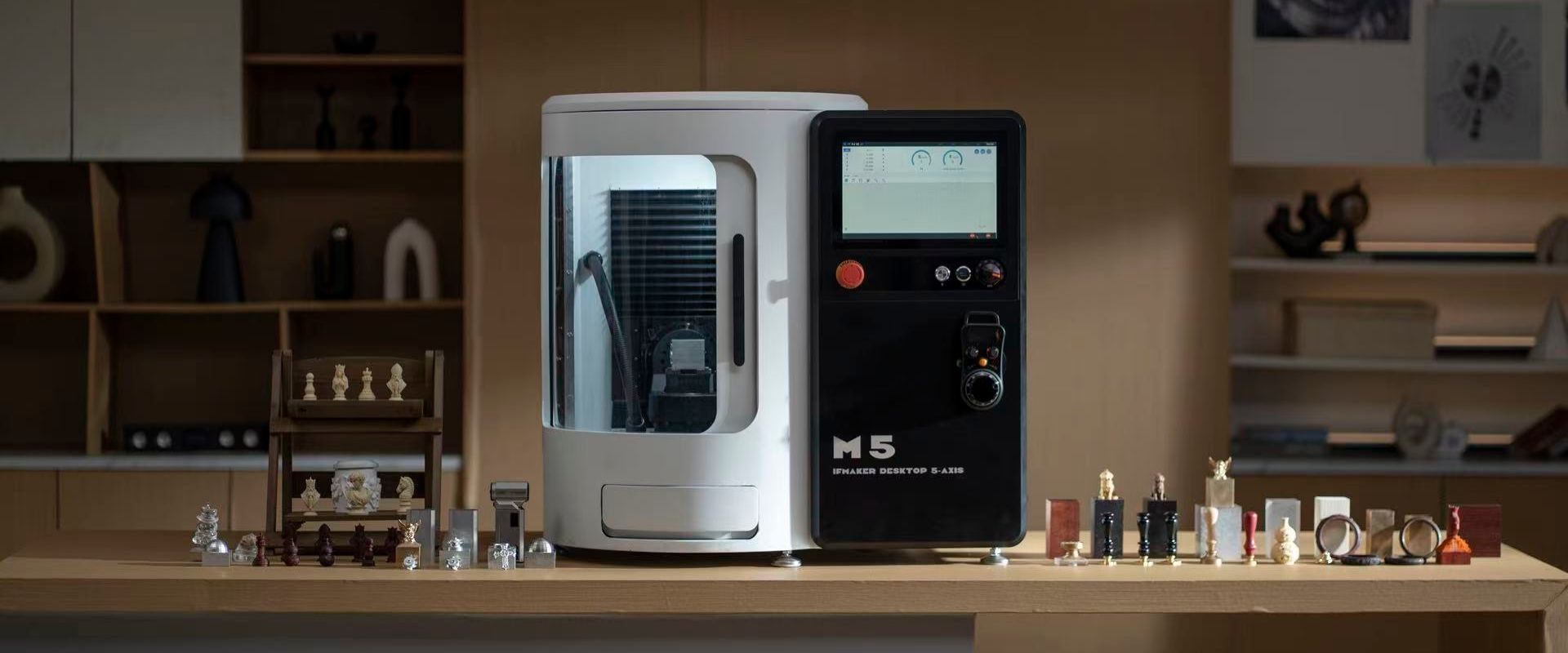
The IFMAKER M5 deserves a detailed article of its own, and I intend to explore the machine separately. This article focuses on a more fundamental question:
Disclaimer
- I received no compensation to write positively or negatively.
- Everything written here is based on my own thoughts and opinions, unless it is product information cited from the specification document, etc.
- I am in no way affiliated with these brands or the products mentioned in this post.
- Official IFMAKER launch page: https://www.comingsoon.ifmaker.xyz/
- Official IFMAKER Website: https://www.ifmaker.xyz/
Who is IFMAKER?
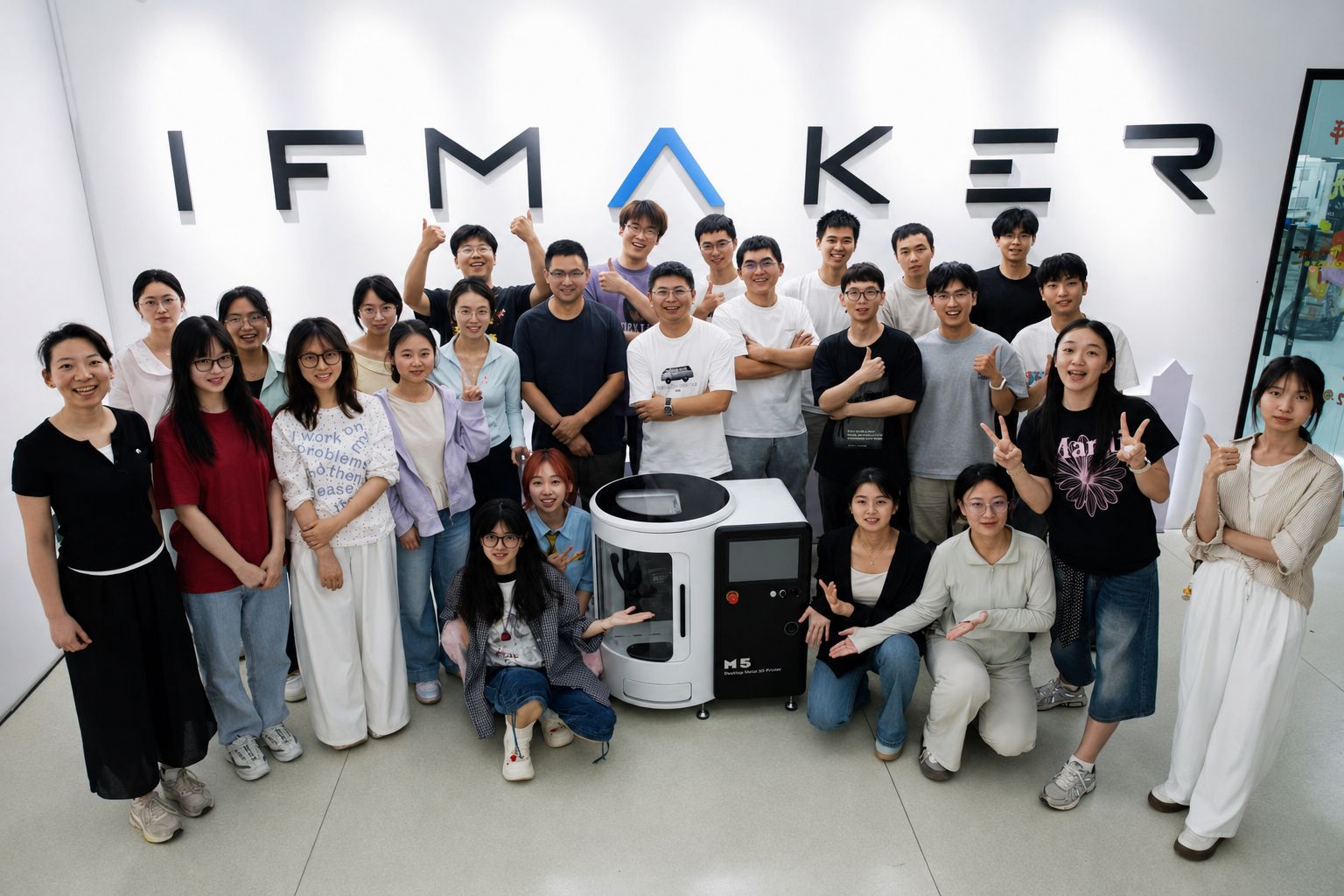
IFMAKER is the brand of Yifang Control (Shanghai) Co., Ltd., a CNC technology company based in the G60 Science and Technology Innovation Corridor in Songjiang, Shanghai.
The company was formally registered in May 2023, with its main research and development programme beginning during the same period.
That makes IFMAKER relatively new as a company—but the engineers behind it are not new to CNC.
Its team brings together engineers, software developers, industrial designers, robotics specialists, manufacturing professionals and makers. According to IFMAKER, its full-time core team consists of approximately 40 people working across mechanical development, motion-control algorithms, CAD and CAM software, artificial intelligence, servo electronics, industrial design, production and international market operations.
The company describes its purpose in direct terms:
“We do not see ourselves as a conventional heavy-machine-tool manufacturer. We see IFMAKER as a company removing the barriers around precision manufacturing.”
That distinction is important.
IFMAKER is not merely attempting to make an industrial CNC machine smaller. Its stated goal is to reconsider the complete CNC workflow—hardware, software and user interaction—from the perspective of an independent creator.
The Meaning Behind the Name
The name IFMAKER is not an accidental combination of words.
The IF comes from “What if?” It represents creative hypotheses, unusual ideas and designs that have not yet been transformed into physical objects.
The MAKER represents the person who wants to make that transformation happen.
As the company explained:
“Our team believes that all creation begins with an ‘if’: What if this sketch could be carved into metal? What if a complex, curved artwork could be produced on a desktop?”
The name therefore communicates the company’s central idea: imagination should not be stopped simply because the available manufacturing tools are too expensive, too large or too difficult to operate.
“The name expresses our central mission—to turn imagined possibilities into physical objects and make low-barrier five-axis machining technology available to creators.”
It is a strong name because it contains both the question and the person attempting to answer it.
There is the possibility—IF—and there is the person who makes it real—the MAKER.
A Company Born From Personal Frustration

IFMAKER’s founder and CEO, Li Chao, has spent approximately 16 years working in CNC system research and development.
He studied mechatronic engineering at Shanghai Jiao Tong University and previously worked on CNC control systems, robotic machining, laser-cutting software and precision engraving technology.
His experience includes serving as a senior engineer on the early team behind the i5 CNC system at Shenyang Machine Tool. He later held technical leadership positions involving robotics, laser systems and precision CNC equipment.
However, the idea behind IFMAKER did not begin only in an industrial research environment. It also came from Li Chao’s own frustration as a maker.
At one point, he wanted to produce a custom camera grip and modify an instant camera. Despite his CNC experience, he could not find a compact five-axis machine that was both capable and reasonably approachable.
He ultimately had to use hand files and an angle grinder.
For someone with extensive CNC knowledge, this revealed an uncomfortable contradiction. Advanced manufacturing technology existed, but it remained inaccessible for many small, personal projects—even to people already familiar with the industry.
IFMAKER explained:
“The belief behind his decision to create a consumer CNC company is that high-precision five-axis manufacturing should not belong only to factory professionals.”
The founding team believed the CNC market had become divided into two extremes.
At one end were large, expensive industrial machines intended for professional factories. At the other were smaller desktop systems that were more accessible but often limited in rigidity, power, accuracy or axis capability.
The opportunity, as the team saw it, was to create something between those categories: a compact machine that retained serious engineering principles while making the workflow more understandable to individual users.
The Cast-Iron Decision
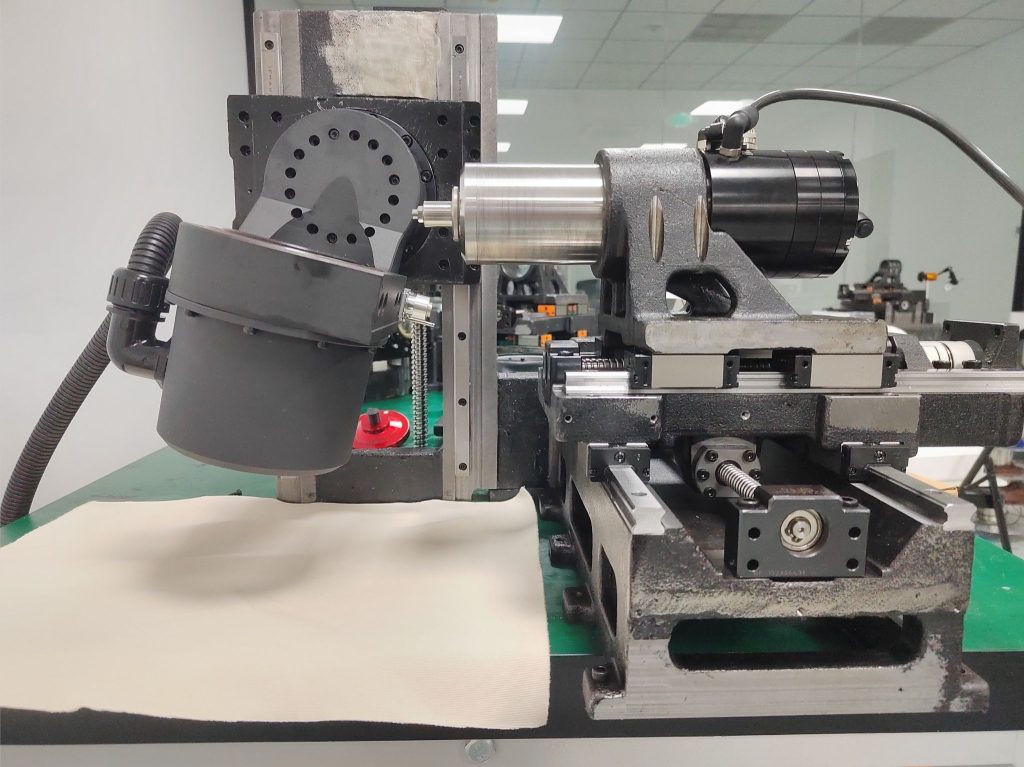
One aspect of IFMAKER’s approach immediately stood out to me: the company chose a cast-iron structure.
Not die-cast aluminium.
Not an aluminium extrusion frame.
Not a machine assembled primarily from aluminium plate.
Cast iron adds considerable weight, and that weight creates obvious shipping and handling challenges. However, machine tools do not benefit from being light in the same way that laptops or portable electronics do.
Rigidity and vibration damping matter.
Anyone who has operated certain lightweight desktop CNC machines will understand the problem. Under the wrong cutting conditions, some of them can sound and behave like a 2002 Nokia phone vibrating across a glass table.
That vibration is not merely irritating. It can affect surface finish, tool life, accuracy and the stability of the cutting process.
IFMAKER says the M5 uses a 135-kilogram integrated cast-iron structure. According to the company, the base went through close to ten design iterations as the engineering team worked to balance rigidity, vibration control and overall machine size.
The company summarises its approach as:
“Industrial-standard hardware combined with human-centred intelligent software.”
IFMAKER says its engineers were unwilling to achieve a smaller footprint by relying on thin, lightweight structures that would compromise machining stability.
“Miniaturisation must not mean sacrificing performance.”
The machine’s reported use of industrial servo systems, C5 ball screws, linear guides and high-rigidity transmission components supports that philosophy.
These specifications and performance figures remain manufacturer claims, but the underlying design decision is clear: IFMAKER believes a desktop CNC should still behave like a machine tool.
Making CNC Easier Without Turning It Into a Toy
Building a smaller CNC machine is only one part of the challenge.
The other challenge is software.
Industrial CAM systems are powerful, but they can require substantial training. New users must learn cutting strategies, feeds and speeds, workholding, tool selection, coordinate systems, collision avoidance and G-code.
Five-axis machining introduces another layer of complexity.
IFMAKER believes that the largest barrier preventing more people from using CNC equipment is not one isolated issue. It is the combined weight of software complexity, machine cost, setup requirements and specialised manufacturing knowledge.
The company’s answer is to place more of that complexity behind the interface.
Its internally developed IFCAM software is designed around two operating approaches: an accessible mode for artists and creators, and a more detailed professional mode for experienced engineers.
In the simplified workflow, IFMAKER says the software can assist with toolpath generation and the selection of machining parameters for materials such as wood, aluminium, jade and other alloys.
The professional workflow retains more direct control over machining parameters.
“The machine carries the industrial workload; the AI software carries much of the technical complexity for the user.”
That statement captures the intended relationship between the hardware and the software.
The objective is not to remove capability. It is to prevent the user from being confronted with every layer of that capability at once.
Professional users may still want detailed control. A jewellery designer, artist or student, however, may simply want to begin with a model and understand how to turn it into a finished object.
IFMAKER wants both users to be able to approach the same system at different levels.
Why Five-Axis Access Matters for Education
One limitation I have personally noticed in technical education is the lack of access to real multi-axis machining equipment.
Students may learn CAM software. They may create simulations and watch virtual toolpaths move around a digital model. They may understand the theory of multi-axis machining.
However, simulation is not the same as watching a real machine produce a real part.
There is an important moment when a digital toolpath becomes physical—when the student sees workholding, tool engagement, surface finish, machine movement and material behaviour working together.
That is where theory becomes engineering experience.
A more accessible compact five-axis machine could create new opportunities for practical CNC education.
High schools with developed technical programmes may be able to introduce students to more advanced manufacturing principles. Universities and technical colleges could give engineering students direct exposure to five-axis workflows without relying entirely on large industrial equipment.
Companies operating apprenticeships or workplace training programmes could also connect CAM theory with practical part production at a smaller scale.
IFMAKER also sees education as an important application.
“We believe this type of machine can become useful in engineering education, independent art practice and small prototyping studios.”
The significance is not that a desktop machine will replace a full-sized industrial machining centre. It will not.
The value lies in access.
Students can make mistakes, test ideas, examine the results and build practical intuition before entering a larger industrial environment.
That may be one of the most meaningful applications of this category of machine.
The People Behind the Engineering
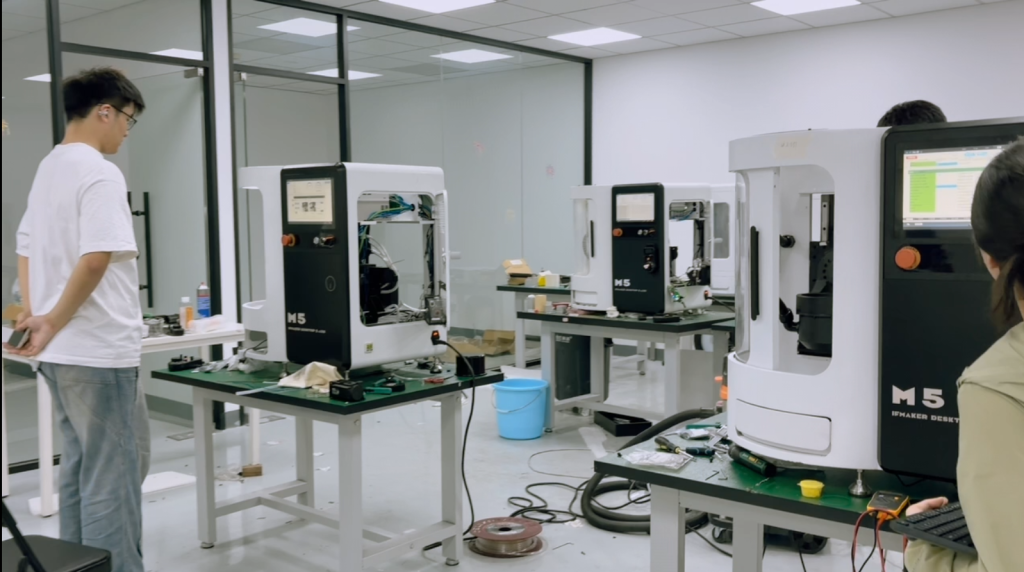
Although Li Chao is central to IFMAKER’s technical direction, the company is not built around one engineer alone.
Co-founder Xin Shengnan holds an MBA from the University of International Business and Economics and has approximately ten years of experience in global industrial markets. Her previous experience includes senior commercial roles at Cummins and Luoshi Robotics.
At IFMAKER, she is involved in the company’s international operations, business development and global market strategy.
The company’s chief mechanical designer, Dang Jianhua, has approximately 20 years of experience in five-axis machine-tool development, including previous work at Shenyang Machine Tool and Haitian Jinggong.
His responsibilities include the machine’s cast-iron structure, spindle system and mechanical rigidity.
The wider team combines experienced industrial engineers with younger designers and programmers.
That balance is deliberate.
IFMAKER says its senior engineers contribute decades of machine-tool and manufacturing knowledge, while younger team members bring a stronger connection to contemporary maker culture, interface design and emerging creative workflows.
The company describes its internal culture through two principles:
Engineering integrity and empathy for creators.
Engineering integrity means not removing important hardware or reducing technical development simply to create a cheaper or more marketable specification sheet.
Empathy for creators means looking at the machine from the perspective of the artist, designer, student or independent maker who must actually use it.
“Technical development should be driven by genuine user needs rather than promotional claims.”
More than half of the team, according to IFMAKER, are themselves hobby makers or craftspeople.
That detail matters.
There is a difference between designing a machine for an imagined user and designing one while personally understanding why that user becomes frustrated.
Who Is IFMAKER Building For?
IFMAKER does not identify one exclusive customer.
The company sees several groups as potential users:
- Independent artists and jewellery designers working with complex curved forms
- Product and industrial designers producing functional prototypes
- Small studios creating limited batches of customised products
- Engineering students and educational laboratories
- Experienced makers who require more advanced subtractive-manufacturing capabilities
- Research and development teams producing small functional components
These users may have very different backgrounds, but they share a common problem: they need access to more capable machining without building or hiring an industrial factory.
Five-axis machining can reduce the need to reposition complex workpieces repeatedly. That can make it useful for organic surfaces, sculptural objects and components requiring machining from several angles.
IFMAKER provided one example that it believes represents the company’s purpose particularly well: an aluminium Maine Coon sculpture.
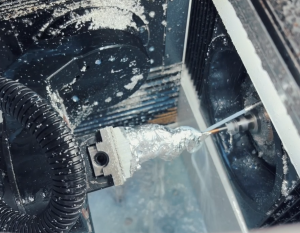
According to the company, the project began with a 689-gram aluminium blank. Following approximately 24 hours of uninterrupted five-axis machining, the finished sculpture weighed 270 grams.
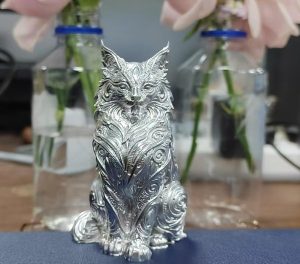
The curved patterns across the body and the layered fur detail around the face were reportedly machined in one setup without secondary fixturing or manual polishing.
For IFMAKER, the importance of the sculpture is not simply that the machine produced a cat.
It demonstrates the ability to preserve detail that a designer might otherwise remove because the manufacturing process is too difficult or expensive.
“For the team, this example represents the aim of preventing manufacturing limits from forcing creative compromise.”
Subtractive Manufacturing Beside 3D Printing
Desktop manufacturing is often associated primarily with 3D printing.
3D printers have made it possible for individuals, schools and small businesses to produce physical objects from digital models at relatively low cost.
Laser cutters have done something similar for sheet materials, engraving and two-dimensional profiles.
CNC machining fills a different role.
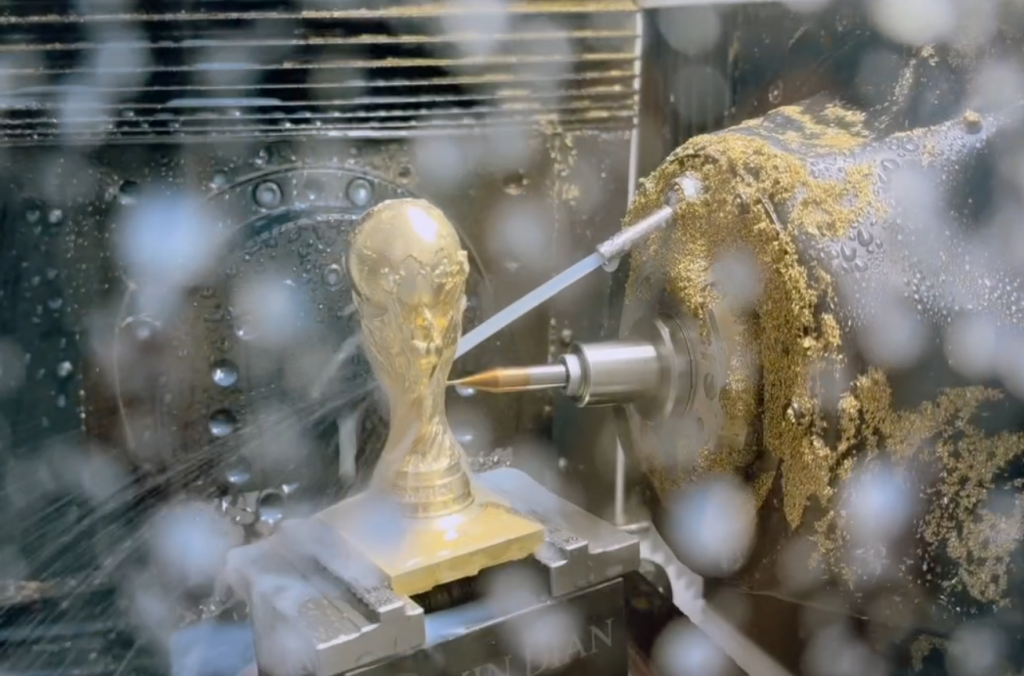
Rather than building an object layer by layer, CNC is a subtractive process. It removes material from a solid piece of wood, metal, engineering plastic, stone or another machinable material.
This makes it possible to produce parts with different structural, surface and material properties from those typically associated with desktop 3D printing.
IFMAKER does not frame CNC as a replacement for additive manufacturing or laser cutting. It sees these technologies as complementary.
“The global maker industry is moving from a model centred mainly on additive 3D printing toward desktop manufacturing that combines additive and subtractive processes.”
A designer may use 3D printing for an early concept model, CNC machining for the final metal component and laser cutting for an enclosure or supporting structure.
The future workshop may not be defined by one machine. It may be defined by several digital manufacturing tools working together.
More Than a Smaller Industrial Machine
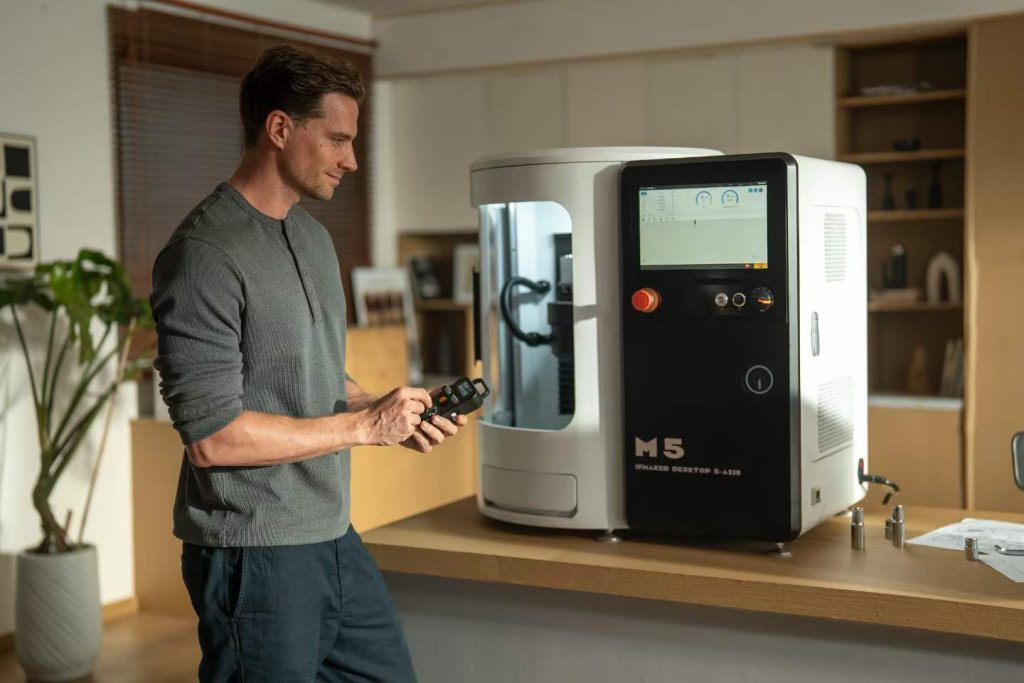
One of the most common assumptions about desktop CNC equipment is that a smaller machine must be a weakened industrial machine.
In many cases, that assumption is understandable. Compact equipment often sacrifices mass, rigidity, cooling capacity or spindle performance to achieve a lower price and smaller footprint.
IFMAKER argues that the desktop five-axis category should instead be treated as a distinct class of tool.
“We are not merely making a factory machine smaller. We are reconstructing the hardware and software system from the ground up for personal creative work.”
That may be the most useful way to understand the company.
IFMAKER is not attempting to compete directly with a multi-ton industrial machining centre producing automotive or aerospace components on a factory floor.
It is asking a different question:
What would five-axis CNC look like if it were designed specifically for an independent designer, a technical classroom, a jewellery studio, a product-development workshop or an advanced maker?
The answer requires more than reducing the dimensions of the enclosure.
It requires rethinking the interface, the software, the training process, the safety systems, the physical structure and the relationship between the user and the machine.
Conclusion - So, Who Is IFMAKER?
IFMAKER is a young company built by people with long experience in CNC, robotics, software and industrial manufacturing.
Its central belief is that access to precision manufacturing should expand beyond large factories and specialist operators.
The company is attempting to combine the rigidity and control principles of industrial CNC equipment with software designed for people who may not have years of machining experience.
Whether IFMAKER ultimately succeeds will depend on execution.
Desktop five-axis machining is an ambitious category. Users will expect accuracy, reliability, service, software stability and real-world performance—not only impressive specifications.
Those questions will be better explored in a separate, product-focused examination of the IFMAKER M5.
However, the company’s purpose is already clear.
It wants creators to begin with the object they imagine rather than the limitations of the tools available to them.
IFMAKER summarises that purpose in one sentence:
“IFMAKER exists because every imagination deserves to be fully made into reality without compromise.”
And perhaps that brings us back to the question that started this article.
What if?
What if advanced CNC machining could become more accessible?
What if students could move beyond simulation and operate a real multi-axis machine?
What if an artist could machine a complex metal form without commissioning a large industrial workshop?
What if the distance between imagining and making became smaller?
Those are difficult questions.
But difficult questions are often where engineering begins.
Reach them via their official website: https://www.ifmaker.xyz/
Editorial note: Technical specifications, performance figures and product capabilities referenced in this article were supplied by IFMAKER. They are presented as company statements and have not been independently verified by the author.
Want to get featured in a blog drop a mail: yt@jacofield.com
Author Profile